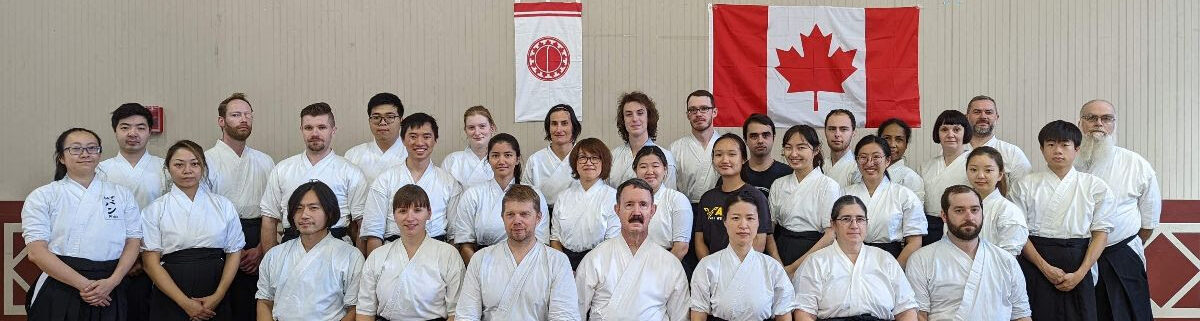
The 2026 INF International Naginata Seminar was hosted by the Australian Naginata Federation from June 26th to 28th in Melbourne, Australia. The seminar was taught by:
Chinobu Imaura, Kyoshi
Toko Takahashi, Kyoshi
Ayumi Nakadan, Kyoshi
Alex Bennett, Godan
Canada was represented by Sam Zhou, Henintsoa Rakotomalala, and Jeffree Chen.
Jeffree, Sam, and Henintsoa, with Peter, from the Sydney dojo where Dan Bouchard-sensei used to practice
Over the three days, the group practiced a variety of things, including basics, shikake-oji, and kata, and received a lot of valuable feedback from both Australian and Japanese sensei. The weather was chilly (it was winter in Australia!), but the warm company and lots of practice kept everyone warmed up. It was also a chance to catch up with old friends and make new ones with naginata-ka from all over Asia and Oceania: from Australia, Hong Kong, Malaysia, and New Zealand. The seminar ended with a mock engi and shiai tournament.
Overall, it was a very fun and valuable experience, and our delegation learned a lot!
A quiet moment taking in the Melbourne skyline before heading home
The 2026 CNF National Seminar took place on June 27th and 28th at the Association Récréative Milton-Parc in Montreal. Practitioners from across the country came together for two days of keiko, covering fundamentals, shikake-oji, kata, and shiai-geiko, along with a grading on the Sunday.
Here’s what a couple of participants had to say (translated from French):
“The seminar was well organized and the instructors gave clear explanations. I appreciated the opportunity to practice with participants of different levels and to connect with the community.”
— Kylian Lionnet, D.N.C.U.M, 2026
“It was pretty fun! I liked that the levels were mixed from time to time, but I imagine it’s most fun for beginners XD.”
— Amiel Gélinas, D.N.C.U.M, 2026
Thank you to everyone who attended, taught, and helped organize this seminar. We hope everyone left feeling motivated and equipped with new skills and knowledge to bring back to their home dojos!
The 2026 Toronto Naginata Tournament was held on May 23, 2026, in Toronto, Canada. The tournament had a record number of participants this year, including a large cohort from the USA. Thank you very much to Jordan Macklem for organizing the tournament!
After 85 total matches, the final results were:
Individual Shiai 1st – Jordan Macklem (JCCC) 2nd – Marija Landekic (Rosemont) 3rd – Dan Bouchard (Burnaby) 3rd – Andrew Boyd (River Valley)
Congratulations to all, and thank you to everyone who came out to compete, volunteer, and cheer each other on!
All the participants and medalists from this year’s tournament!
Thank you to Felice Guo for the tournament photography!
Sam Zhou (3-dan, CNF Media and Communications Officer) had the chance to practice at several different dojos across Japan. Here are the highlights:
I had the opportunity to spend several months in Japan and to visit 4 different dojos from Hokkaido to Kyushu, and it was interesting to see how different kinds of practices were done.
Sapporo
I went to a couple of dojos in Sapporo (there are essentially only 2 dojos in Hokkaido, and both are in Sapporo). The Chuo-ku Kitagas Arena dojo is a community dojo mostly attended by elderly women. Practices there focus primarily on datotsu (basics) and shikake-oji, with some kata occasionally. I also went to the high school practices at Hokkaido Sapporo Intercultural and Technological High School with UTNC alum Andi Li. High school practices are a different pace: around 3/4 of it is bogu practice. The club is mainly run by older students and university students who are alumni of the high school. They were preparing for Interhigh, so they were doing many repetitions of drills. Practices were 4 hours on the weekends, with water breaks every half hour for 10 minutes or so, then back at it again with more datotsu, short strikes, nuki-waza, and enjin-geiko (circle keiko). They also made up fun exercises to practice the timing of strikes.
Kobe
Oji Sports Center Dojo
I also travelled to Kobe to practice at the Oji Sports Center dojo with Lutan Liu (UTNC alum). This was again a community dojo, but with a different range of participants. Here, people are of all ages, from middle school girls and their dads to older adults in their 40s-50s and up. There’s something for everyone.
I (on the right side here) managed to get a sune strike in hehehe 😛
Bogu practice was led by Lutan, and I got to keiko with students from a nearby university who want to start a new naginata club.
Kumamoto
The following week, I went to Kumamoto. A magnitude 6.8 earthquake struck there the day before my flight, but since my flight wasn’t cancelled, I went anyway. Kumamoto itself was still in functional shape overall; it was hit much harder further south in the city of Uki, which was the epicentre. Life went on after the earthquake, though there were small aftershocks rolling through in the evenings.
I went to visit Reigando Cave, where the famous Miyamoto Musashi spent the last years of his life writing The Book of Five Rings, among other works. I thought I’d pay my respects and do a little hike through the mountain highways, among kumquat trees and bamboo forests.
My main goal in Kumamoto, though, was to attend a naginata practice. The Interhigh competition was coming up, and to prepare, Kumamoto Daiichi High School held a special training practice on the weekend. A friend I met through the INF, who worked in the JET (Japan Exchange and Teaching) Program, practices regularly at that high school, so I got to attend this practice.
Kumamoto used to be a powerhouse for high school naginata, with Kumamoto Nishi High School winning 5 consecutive team championships back in 2001. They were supposed to come to this special training too, but with the earthquake, they weren’t able to make it. I got to keiko a bit with the students. They were very fast, and you could tell that they are a very strong team.
I hope by sharing these experiences and stories that naginata practitioners outside of Japan can get a better idea of what practices at dojos are like around different parts of Japan. If you are travelling to Japan and want to practice naginata there (and are a member of the CNF), make sure to contact the CNF (ideally a couple months beforehand) and we could potentially help connect you!
This spring, Kaori Kubo, along with Mary Phan and Marija Landekic travelled to Japan to train in Okayama and Himeji. Congratulations to Kaori-sensei for taking the Renshi exam and on achieving the title of Renshi! Here are some highlights from the trip:
Okayama gasshuku on May 3rd. High school and adult players from 6 prefectures took part in an 8-hour practice, with around 80 participants that day. Photo credit: @mimasaka.naginataHimeji Prefectural Budokan practice on May 8th. My high school teacher runs the dojo there. The Renshi exam was held in the budokan this year. Photo credit: @himeji_naginataOur visit to Musashi Shrine in Mimasaka city, just a 30-minute drive from my home, if anyone is interested in visiting one day!
“We had 30 Renshi candidates this year, and we took the exam by age. 9 of us had successful results.”
The Canadian Naginata Federation was thrilled to host its annual Seminar in Toronto this October. Members from across the country attended three days of intense seminars which culminated in Shinsa of up to 3rd Dan. Thank you to Kaori Kubo and Jordan Macklem for coordinating the seminar.
We are grateful to our guest instructors for taking the time to visit Canada and teach us, and we hope to see you again soon! Thank you: Ryoko Tanimoto-sensei (Kyoshi, AJNF) Naoko Okura-sensei (Renshi, AJNF) David D’hose-sensei (Renshi, ENF)
The Canadian Naginata Federation was thrilled to send a large contingency to this year’s 8th World Naginata Championships held in Boulder, Colorado. We would like to extend our heartfelt thanks to both the USNF and INF for making such an event possible!
Team Canada had an amazing showing! In particular, we would like to highlight:
Marija Landekic: 4th Place Women’s Individuals
Lutan Liu: 1st Place Women’s Goodwill Taikai
Daiki Iriyama: Goodwill Taikai Fighting Spirit Award
Our first ever WNC rhythm performance coordinated by Birgit and Daiki Siegert-Iriyama was extremely well-received and all new Team Canada members performed incredibly well. Truly amazing work by our first-timers and we look forward to seeing your progress in Naginata!
As for grading results, every member of the CNF who attempted grading or certification was successful! 1 – Ikkyu 2 – Shodan 1 – Sandan 4 – Yondan 3 – Shimpan-in
The Canadian Naginata Federation held its Annual General Meeting on April 28th, 2024. The representatives from each dojo of the Federation were presented with updates from the Board’s officers, and an update on the status of the Federation, including membership numbers and finances. As part of this meeting, two new members of the Board of Directors were elected by the voting members.
The CNF Board of Directors welcomes Dan Bouchard (Alberta) and Jordan Macklem (Ontario) to the team! This brings the total member count of the Board to 5. In alphabetical order, your current Directors are:
Alan McDougall (Alberta)
Dan Bouchard (Alberta)
Jordan Macklem (Ontario)
Kaori Kubo (Ontario)
Marija Landekic (Quebec)
The Board is always here to serve. If you have question, concerns, comments, or ideas that you would like put to the leadership of the Federation, please speak with your dojo leader. They can in turn inform us, and the Board of Directors is happy to discuss!
The 2024 Toronto Naginata Tournament was held on May 11-12th 2024 at Loretto College School, Toronto Canada. Thank you very much to Jordan Macklem for organizing the tournament!
Individual Shiai 1st – Marija Landekic 2nd – Jordan Macklem 3rd – Alex Lin
Team Shiai 1st – Team Terra (David Luong, Will Choi, Andrew Boyd) 2nd – Team Venus (Taiga Jay, Rose Ly O’Brien, Jordan Macklem) 3rd – Team Jupiter (Khoa Doan, Athena Vithal, Kaori Kubo)
Shikake-Ouji 1st – Jordan Macklem / Marija Landekic 2nd – Mary Phan / Kaori Kubo 3rd – Andrew Boyd / Dan Bouchard
The Canadian delegation at the 42nd All Japan Student Naginata Federation Seminar held in Tokyo from Feb 29 to March 3!
At this seminar, we drilled on fundamentals, worked on shikake-ouji, had bogu practice, learned about emergency first aid, and did rhythm performances! Thank you so much to sensei and the AJSNF for allowing us to participate in this seminar. We learned so much and had a lot of fun practicing and meeting everyone!